
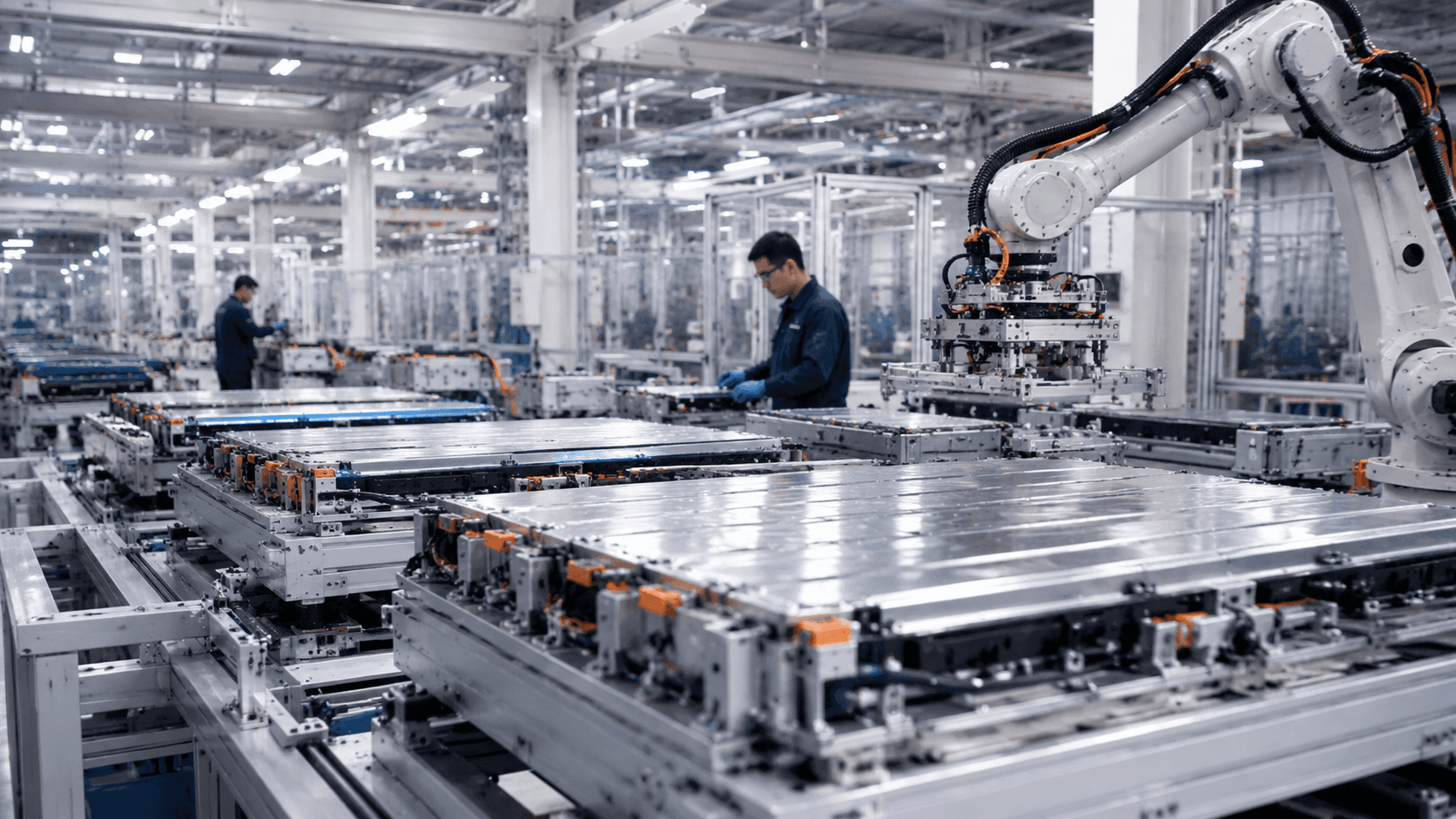
JFK Park's EV-charging plan now calls for fewer plugs than it once did, but New York City's economic-development agency says the redesign should move roughly three times as many vehicles through the site.1
The posted minutes from NYCEDC's June 16 board meeting record unanimous approval of a deed change that replaced an earlier requirement for at least 65 EV charging stations, including at least 12 fast chargers, with at least 38 fast chargers and no required slow chargers.1 The distinction matters: the project did not simply swap 65 equivalent fast chargers for 38.
NYCEDC and developer Wildflower announced the project's groundbreaking on September 9 and said construction is underway on the 2.6-acre site beside JFK Airport in Queens. The current plan is for 38 DC fast-charging stalls operating 24 hours a day, each rated at up to 400 kW and equipped with NACS and CCS cables. Mercedes-Benz High-Power Charging is the named operator.2
The hub is not open yet. NYCEDC says completion and operation are anticipated in late fall 2027.2
Why the project went from 65 stalls to 38
The June board record gives a more detailed explanation for the lower stall count than the September groundbreaking announcement does. According to the posted minutes, Wildflower had secured an experienced charging operator and obtained a Con Edison electrical upgrade that substantially increased the site's planned electrical capacity.1
NYCEDC's board materials say the additional power and operator input made an all-fast-charging configuration possible. The same materials compare the revised plan with an average charging time of about 20 minutes instead of roughly eight hours under the earlier mixed-speed concept, and project annual vehicle-charging capacity rising from about 100,000 to about 300,000.3
Those are project estimates, not measured results. NYCEDC officials told the board that they considered vehicle throughput a better comparison than raw charger count and said the all-fast design translated to roughly three times as many vehicles moving through the site.1
The project's earlier public versions were materially different. NYCEDC's March 2024 selection announcement described 65 EV-ready charging stations, including 12 rapid chargers.4 When NYCEDC and Wildflower announced the land closing in December 2025, the public plan still called for 65 EV-ready stations with at least 12 rapid chargers.5
The June 2026 board action therefore changed both the minimum number of charging stalls and the required charging mix: at least 38 fast chargers, with no required slow chargers, replaced the old 65-station requirement.1
What 400 kW does — and does not — mean
The September announcement says each of the 38 planned chargers will be rated for up to 400 kW.2 That is a per-stall equipment rating, not evidence that the site will deliver 38 times 400 kW simultaneously. The public records reviewed for the research packet do not establish the hub's final aggregate electrical-service capacity.21
It also does not establish that every EV using the site will charge at 400 kW.26 Mercedes-Benz describes its North American high-power network as serving EVs from multiple brands and using equipment rated up to 400 kW, but that does not turn 400 kW into a universal vehicle charging rate.6
For now, the concrete milestone is construction rather than operation. The 38-stall all-fast design is the current announced configuration, and NYCEDC says the redesign is intended to increase the number of vehicles the site can serve despite the lower stall count.21
Sources
Footnotes
-
Minutes of the Regular Meeting of the Board of Directors of NYCEDC — June 16, 2026 — New York City Economic Development Corporation, posted as a DRAFT meeting record. https://edc.nyc/sites/default/files/2026-08/NYCEDC-Board-Minutes-6-16-26-DRAFT.pdf. Records the unanimous deed-modification approval, the change from the 65-station/12-fast minimum to at least 38 fast chargers with no required slow chargers, the operator/Con Edison capacity-upgrade rationale, and NYCEDC's roughly three-times-throughput statement. ↩ ↩2 ↩3 ↩4 ↩5 ↩6 ↩7
-
"Wildflower LTD Breaks Ground on JFK Park, One of New York City's Largest Public Electric Vehicle Charging Hubs" — New York City Economic Development Corporation, Sept. 9, 2026. https://edc.nyc/press-release/wildflower-ltd-breaks-ground-jfk-park-one-nyc-largest-public-ev-charging-hubs. Establishes the groundbreaking/construction status, current 38-stall configuration, 24/7 plan, up-to-400-kW per-stall rating, NACS and CCS cables, Mercedes-Benz High-Power Charging as operator, and anticipated late-fall-2027 completion/operation. ↩ ↩2 ↩3 ↩4 ↩5 ↩6
-
NYCEDC Board Meeting Book / Exhibit A — Modification to Deed to Wildflower JFK North LLC, June 16, 2026 — New York City Economic Development Corporation. https://edc.nyc/sites/default/files/2026-06/NYCEDC-Members-and-Board-Meetings-Book-6-16-26.pdf. Establishes the proposed all-fast modification and project estimates comparing roughly eight-hour versus 20-minute average charge times and roughly 100,000 versus 300,000 vehicles of annual charging capacity; these are projections, not operating results. ↩
-
"NYCEDC Selects Wildflower to Develop the Largest Public Electric Vehicle Charging Station in New York City near JFK Airport" — New York City Economic Development Corporation, March 20, 2024. https://edc.nyc/press-release/nycedc-selects-wildflower-develop-largest-public-electric-vehicle-charging-station. Establishes the original public 65-EV-ready-station plan, including 12 rapid chargers. ↩
-
"NYCEDC and Wildflower Close on Deal to Build the Largest Public Electric Vehicle Charging Station in New York City Near JFK Airport" — New York City Economic Development Corporation, Dec. 23, 2025. https://edc.nyc/press-release/nycedc-wildflower-close-deal-build-largest-public-ev-charging-station-nyc. Establishes the then-current 65-EV-ready-station plan, including at least 12 rapid chargers. ↩
-
Mercedes-Benz High Power Charging — Mercedes-Benz Group, current page observed Sept. 11, 2026. https://group.mercedes-benz.com/company/north-america/mercedes-benz-high-power-charging.html. Establishes operator background, all-brand positioning and use of up-to-400-kW equipment in the North American network; it does not establish JFK's aggregate site power or a universal vehicle charging rate. ↩ ↩2