
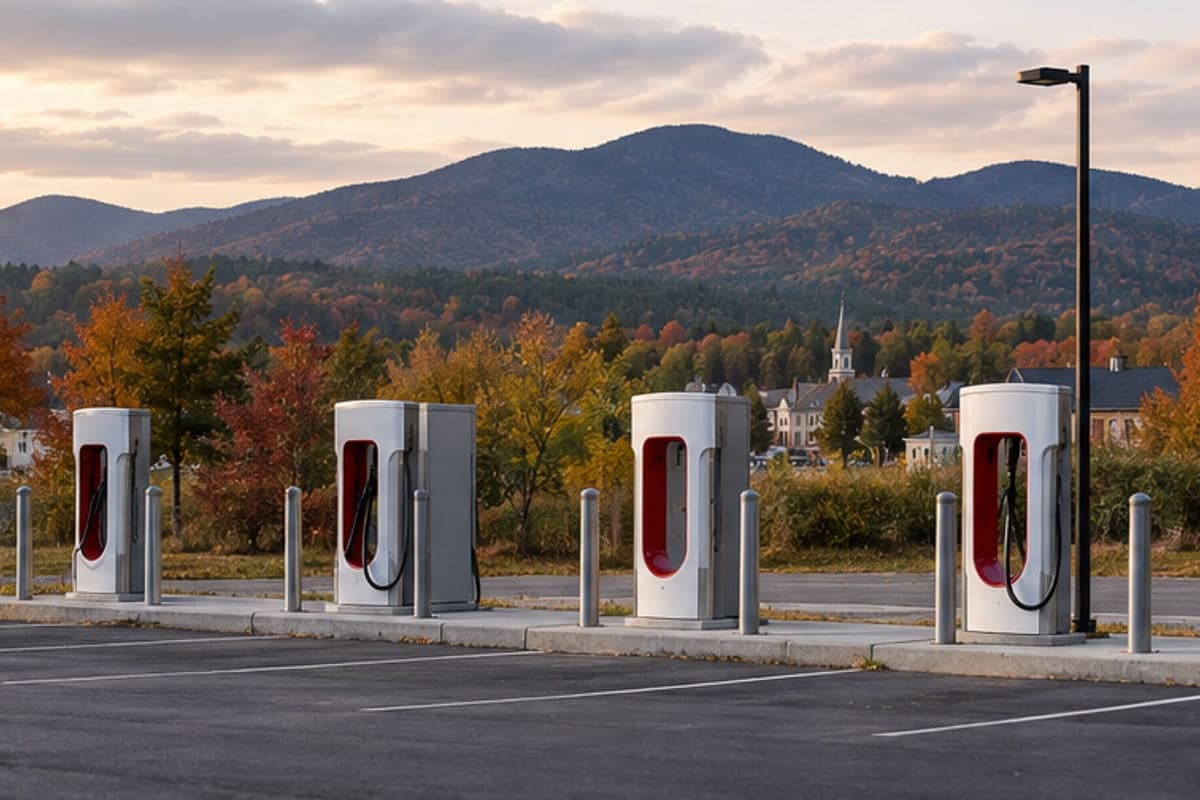
Correction and status update — October 31, 2026: This August 25 article previously described the privately operated Gorham Citgo Supercharger as “still active” and discussed the owner's planned October 25 shutdown as a future event. The date has passed, and that unqualified availability description is no longer appropriate. In its October 31 New Hampshire status view, DCFC Tracker reported the Gorham station offline since October 25; its station history calls the reported change “temporarily unavailable.” Tesla's public directory continues to show standard 24-hour access hours, but that is not a real-time check of functioning stalls. Neither listing confirms that the operator permanently closed the site, why it became unavailable, or whether a driver can charge there now.123
Before depending on this charging stop, verify its current availability in the Tesla app or your vehicle's charging navigation. The status data below are a dated comparison, not a live operational guarantee.3
New Hampshire's 2026 Phase II National Electric Vehicle Infrastructure (NEVI) solicitation named Gorham as a potential location for additional fast charging. At the same time, the owner of an existing privately operated, Tesla-listed four-stall site in town told the Concord Monitor that electricity bills were running at more than twice charging revenue and that he planned to shut down the chargers October 25. Those were his reported August figures and intention—not evidence that a closure was subsequently completed.41
What the October 31 station listings actually show
The reports refer to the same four-stall location at 443 Main St., Gorham, New Hampshire. They serve different purposes and cannot be treated as interchangeable real-time tests.235
| Source checked | What its public record shows | What it does not establish |
|---|---|---|
| DCFC Tracker, October 31 review | “Offline since Oct 25” and “still offline” on its New Hampshire changes page; station history says “reported temporarily unavailable” on October 25 | Direct operator/Tesla confirmation, physical disconnection, outage cause or permanent closure |
| Tesla Find Us directory, recent indexed listing | Four stalls, up to 300 kW, standard 24/7 access hours; expressly not Tesla-owned | Live stall availability or proof charging sessions are succeeding |
| AFDC-origin station record shown by ChargeCensus | Station marked “available,” but underlying inventory last updated October 13, before the October 25 signal | October 31 operational availability or a refutation of the newer report |
Sources: DCFC Tracker's October 31 New Hampshire display and station history; Tesla's public station directory; the AFDC-origin record with its displayed October 13 source timestamp.325
The matching October 25 dates are notable: the owner had identified that as his intended shutdown date, and the tracker records temporary unavailability beginning then. But the coincidence does not establish that the owner carried out a permanent shutdown, that the reported outage was intentional, or that electricity costs caused the status change. The available public material checked for this update does not include a current firsthand operator confirmation or authenticated Tesla-app charging result.132
Why the owner said charging costs were unsustainable
Terry MacGillivray, president of Summer Fun Inc., told the Concord Monitor's David Brooks that the chargers had generated almost $15,900 in net charging revenue through mid-August against more than $32,500 in electricity bills. Comparing those owner-reported amounts yields a gap greater than $16,600, with electricity bills slightly more than double net charging revenue even before the site's reported capital investment and other expenses.1
MacGillivray also told the Monitor that he had invested $407,000 in the charging project and that more than 1,200 vehicles had charged there since the May installation, nearly half reportedly non-Teslas. Vehicle counts alone do not establish energy delivered, load factor or an industry-standard utilization rate. The underlying invoices and Tesla/network payment-settlement records were not independently obtained by this newsroom.1
The site is listed in Tesla's public directory but expressly identified as not owned by Tesla. An operator's August plan for a privately owned site is not a Tesla corporate announcement or an official network closure notice.621
The utility-rate problem is more complicated than a single demand charge
MacGillivray told the Monitor that his July Eversource bill was $13,211.73, including $10,679.64 in delivery charges. The original report separately discusses demand charges. Delivery charges are not synonymous with demand charges; the entire $10,679.64 should not be described as a demand-charge bill.1
Eversource's published Rate EV-2 tariff was designed for separately metered qualifying public fast-charging loads with more than 100 kW of maximum demand and at least 90% of the metered load dedicated to EV charging. Its published terms set an initial cutoff for new applications after August 15, 2025, pending a further New Hampshire Public Utilities Commission proceeding or order.7
The documented EV-2 rate schedule uses a monthly customer charge and per-kWh delivery components rather than showing a demand-charge line item in that schedule. MacGillivray told the Monitor he believed he had missed its enrollment window and had sought reinstatement. The available evidence does not establish the Gorham site's actual billed rate class, that no later enrollment route exists, or that EV-2 would have made this particular station profitable.817
Why the Gorham NEVI solicitation remains relevant
The New Hampshire Department of Transportation's Phase II NEVI solicitation, issued in June with an August 21, 2026 proposal deadline, identified Gorham on the NH-16/US-2 corridor as a potential charging location in Eversource territory. The solicitation made approximately $9.6 million available and required a minimum 20% non-federal match.4
Gorham's inclusion in that solicitation was not an award, a new station opening or a guarantee of operating economics. Public infrastructure funding can help with initial project costs, while site traffic, charging revenue, electricity tariffs and operating arrangements determine a separate part of the financial picture.41
The original August reporting therefore remains a concrete example of the difference between funding installation and sustaining operation. The October 31 status update adds one narrower fact: a third-party tracker reports the existing Gorham site temporarily unavailable after the owner's announced date. It does not establish what ultimately happened to the owner's shutdown plan. Drivers should use the Tesla app or in-car network navigation—not the station-directory hours on their own—before relying on these four stalls.123
Sources
Footnotes
-
“Shutdown of North Country station exemplifies complexities of public EV charging” — David Brooks, Concord Monitor, August 23, 2026. https://www.concordmonitor.com/2026/08/23/nh-ev-charger-shutdown/ Originating on-record interview for Terry MacGillivray's October 25 plan and all non-public owner-supplied revenue, electricity-bill, capital-cost, vehicle-count and tariff comments. Those figures were not independently audited; the story does not establish whether the announced closure was carried out. ↩ ↩2 ↩3 ↩4 ↩5 ↩6 ↩7 ↩8 ↩9 ↩10
-
“Gorham Citgo Supercharger”, October 31 recent indexed official-page rendering — Tesla Find Us. https://www.tesla.com/findus/location/supercharger/486853 Confirms the displayed station directory record, four stalls, standard 24-hour access hours and private-site designation. Direct dynamic web retrieval timed out during October 31 recheck; index content does not establish network-app live status. ↩ ↩2 ↩3 ↩4 ↩5 ↩6
-
New Hampshire station changes and station 459661 history — DCFC Tracker, public rolling view checked October 31, 2026. https://dcfctracker.com/states/nh and https://dcfctracker.com/stations/459661 The state view reports Gorham “offline since Oct 25”/“still offline”; station history describes October 25 “reported temporarily unavailable.” Third-party aggregator; not a site-owner confirmation, authenticated live charger transaction or proof of shutdown cause/permanence. ↩ ↩2 ↩3 ↩4 ↩5 ↩6
-
New Hampshire NEVI DCFC Phase II RFP, DOT 2027-01 — New Hampshire Department of Transportation; government document as mirrored by GovTribe, issued June 9, 2026. https://govtribe.com/file/government-file/rfp-dot-2027-01-dot-pdf Phase II's approximately $9.6 million, 20% match, August 21 proposal deadline, and Gorham as a possible location. The original state-hosted procurement document was inaccessible to the August research tool; no award is established. ↩ ↩2 ↩3
-
“Eastern Depot Restaurant - Tesla Supercharger (Citgo),” AFDC station 459661 — ChargeCensus mirror of the U.S. DOE/NLR Alternative Fuels Data Center station record, checked October 31, 2026. https://chargecensus.com/stations/new-hampshire/eastern-depot-restaurant-tesla-supercharger-citgo-459661 Displays “available” with underlying last-source update October 13, 2026; stale for the later October 25 outage indication and not a live availability test. ↩ ↩2
-
“Gorham Citgo Supercharger” — Tesla Find Us station directory, originally observed August 25, 2026. https://www.tesla.com/findus/location/supercharger/486853 Four stalls, up to 300 kW, address, standard hours, supported EVs, explicit “Site not owned by Tesla.” Historical/static directory metadata do not verify October 31 stall operation. ↩
-
NHPUC No. 10 Electricity Delivery — Rate EV-2, Original Page 65-E — Eversource/Public Service Company of New Hampshire, NHPUC-approved tariff. https://www.puc.nh.gov/regulatory/Tariffs/Eversource-PSNH-Electric-Tariff.pdf Published qualifying-load and original August 15, 2025 enrollment cutoff conditions. This historical tariff page does not resolve the site's actual tariff or all later regulatory proceedings. ↩ ↩2
-
NHPUC No. 10 Electricity Delivery — Rate EV-2, Page 65-F — Eversource/New Hampshire Public Utilities Commission. https://www.puc.nh.gov/regulatory/Tariffs/Eversource-PSNH-Electric-Tariff.pdf Original EV-2 rate design with fixed monthly and per-kWh components rather than a displayed demand-charge line. Does not establish this operator's actual bill or current available rate. ↩